

A tiny fridge in your hand: how Peltier modules work
Flip the current and cold becomes warm. A plain-language look at the thermoelectric module at the heart of ALLCOM Smart Tumbler.
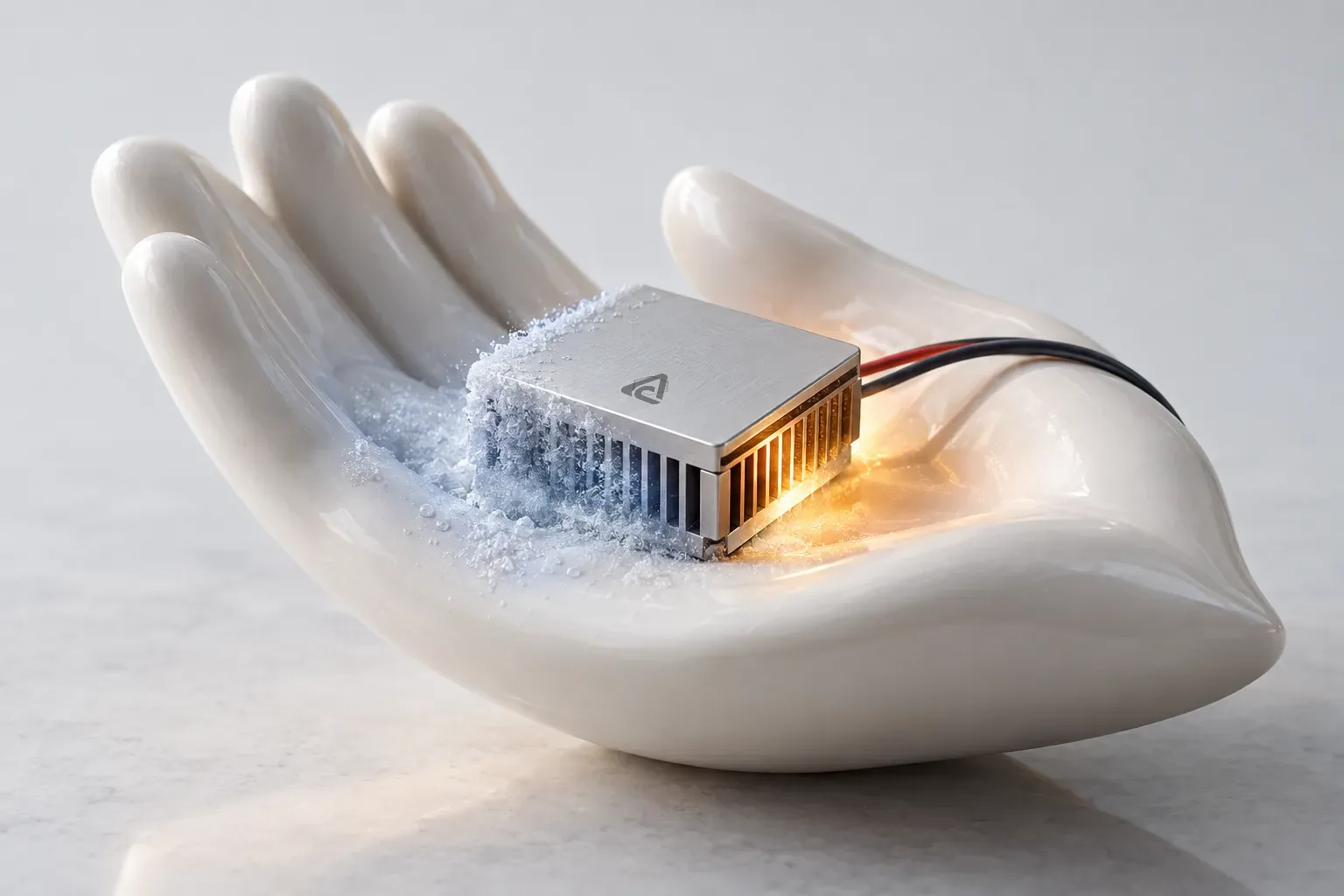
Hot coffee that stays hot. Cold drinks that stay cold to the last sip. The part that makes this possible is the Peltier module.
What is the Peltier effect?
Join two different semiconductors and run a current through them: one side absorbs heat and gets cold, while the other side releases heat and gets hot. French physicist Jean Charles Athanase Peltier discovered this in 1834. The fun part? Reverse the current, and the cold and hot sides swap.
How is it built?
Inside a Peltier module, rows of N-type and P-type semiconductor pellets are linked together and sandwiched between thin ceramic plates. Apply DC power and the moving electrons carry heat from one plate to the other. The heat that comes out is then released through a heat sink or fan.
Why Peltier?
- No refrigerant, so the structure stays simple.
- It can be made very small.
- One module can both cool and heat.
- Adjusting the current allows precise temperature control.
That’s why Peltier modules are used wherever things need to be small and exact: portable coolers, computer components, and lab or medical equipment.
How ALLCOM uses it
ALLCOM Smart Tumbler precisely controls a Peltier module to bring your drink to any temperature from 10–80°C. A sensor reads the drink’s temperature, and the tumbler adjusts the module’s power and direction to heat or cool, then holds it there. One small semiconductor, a big difference in everyday comfort.